

Why Now
Why Now Is the Right Time to Optimize
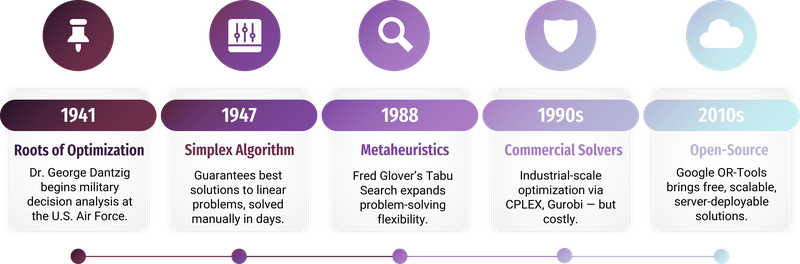
Historical Timeline: Why Optimization is Different Today
-
1941 — Birth of the Field
Dr. George Dantzig joins the Combat Analysis Branch at the US Air Force. This period marks the early days of formal mathematical methods to improve decision-making in logistics and military operations, the roots of modern optimization.
-
1947 — The Simplex Algorithm Revolution
George Dantzig develops the Simplex algorithm, which for the first time guarantees finding the optimal solution to certain classes of problems. Back then, even small problems took days to solve by hand, since computers were in their infancy.
-
1970s–1980s — Rise of Commercial Optimization Software
With the growth of computing, the first commercial optimization packages appear, often running on mainframes. These tools made optimization accessible to corporations but were expensive and limited to those with significant resources.
-
1986 — Metaheuristics Open the Door
Fred Glover introduces Tabu Search, coining the term “metaheuristics.” This allowed tackling large, complex problems that traditional algorithms struggled with, opening up new industries to optimization.
-
1990s–2000s — Server-Based Optimization
The first optimization engines capable of running on dedicated servers emerge, enabling companies to solve larger problems faster. Still, most solutions were proprietary and costly, limiting widespread adoption.
-
2010s — Open-Source & Cloud Democratization
Projects like Google OR-Tools make powerful optimization algorithms freely available. Combined with cloud computing (AWS, GCP, Azure), companies can run optimization models at scale with minimal infrastructure investment.
-
Today — The LLM & AI Acceleration Era
With Large Language Models and AI-assisted development, creating and deploying optimization solutions is faster than ever. No longer bound by expensive proprietary software or narrow-use-case systems, organizations can now build custom optimization models for any process, daily operations or long-term strategic planning, and run them on affordable cloud infrastructure. This transforms optimization from a niche capability into a core operational advantage for all businesses.
Is Optimization the Game-Changer You’ve Been Waiting For?
Optimization has come a long way, from hand-solving equations in the 1940s, to expensive commercial solvers in the 1980s, to open-source, cloud-enabled algorithms today. Each technological leap has brought optimization closer to everyday business use.
But today, a fundamental shift is happening. With the power of AI and Large Language Models, we can design, develop, and deploy optimization models faster, cheaper, and more flexibly than ever before. No longer are you limited to pre-packaged solutions built for only a handful of massive, global problems. Now, you can optimize any process, across the entire system, with minimal cost — and run it on modern servers for best-in-class operational and strategic decisions.
This isn’t just an upgrade in tools, it’s a change in mindset. Operations management and optimization must now be seen as a daily, adaptable decision engine, not a rare, one-off project. The possibilities are bigger, faster, and more accessible than ever.
The time to rethink optimization is now.